Continued from My Canadian Rockies Trip, Part 2, Kootenai Pioneer Village.
Today we headed out to see two scenic parks in two countries, the Waterton Lakes National Park in Canada and the Glacier National Park in the USA. In 1932 they were combined to form the Waterton Glacier International Peace Park, a sign of enduring friendship between the two adjoining nations. It also made eminent sense since the two together form one conjoined ecosystem and makes management of the parks easier.

We headed south from our hotel in Pincher Creek through open prairies with the Rockies to our west. Our guide pointed out Chief Mountain, sacred to the Native Americans and the First Nations of Canada. It is located in Montana and has a distinctive shape rising to an altitude of 5000 feet, clearly visible from the surrounding plains.

We soon entered the small, pretty town of Waterton as our driver Lorn expertly maneuvered the huge coach into a parking spot next to the lake. We could see in the distance the historic Prince of Wales Hotel (named after the Prince of Wales who later became King Edward VIII).

We found a place for lunch and then strolled through the town. We saw a number of deer lounging about or grazing, quite at home in people’s yards. They looked curiously at me, ears and noses twitching, but did not move as I walked past.

We drove to the storied hotel situated on a hillside at the edge of Waterton Lake. It was built by the Great Northern Railway in 1926 as a rest stop for well-heeled travelers visiting Glacier National Park. In 2017, a great fire came within 150 feet of the hotel. It was ultimately saved by the heroic efforts of many firefighters but some of the outer buildings were burnt as well as many trees on the slopes nearby. You can see the hotel and the still-barren slopes in the photo below.
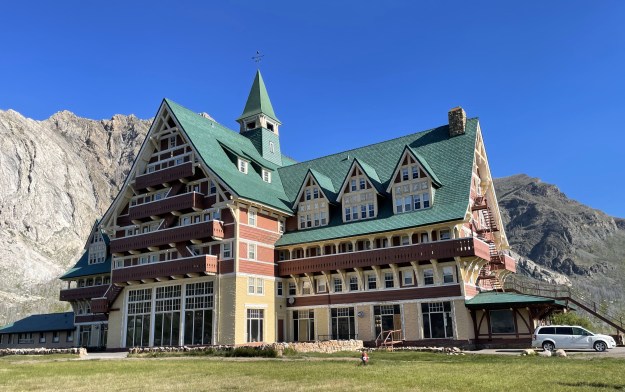
I admired the Rustic Architectural Style of the hotel—the colorful facade, the wood-paneling, the carved beams and stepped inside for a look. It was impressive, replete with old-world charm. I particularly liked the huge ornamental chandelier in the lobby. It would be nice to spend a few days here, I thought.

We then took a short walk down to the lake for some pictures. It was beautiful—the blue shades of the lake and sky offsetting the white clouds and snow dusting the peaks in the distance. The wind funneled through the valley ruffling the lake surface with white wave caps. Amidst all this scenic grandeur we saw a coyote placidly hunting for squirrels and rabbits a short distance from us. It barely looked up, clearly used to gawking tourists.

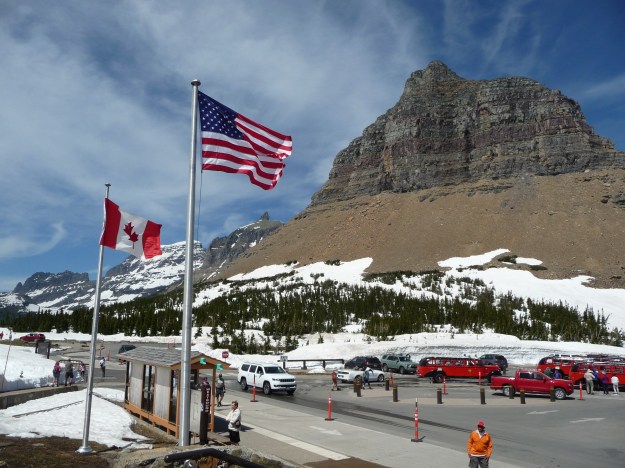
We next crossed the border into Montana, USA, en route to Glacier National Park. A border official collected our passports, checked them and waved us through without any hassle. At the border, we saw the sign for Waterton Glacier International Peace Park formed by the union of Waterton Lakes National Park and Glacier National Park, the world’s first international park under joint jurisdiction by Canada and the USA. One early proponent of this park was George “Kootenai” Brown, whose exploits and contributions are described in Part 2 of this travelogue. We saw the flags of both countries at half-mast in honor of the National Day of Remembrance for Victims of Terrorism.
Soon we entered the park and stopped at Saint Mary Lake, another pristine blue lake surrounded by jagged mountains.

After taking some pictures, it was time to board the distinctive buses of the Red Bus Tour that would take us on the “Going-to-the Sun” Road up to Logan Pass along the Continental Divide. These are historic vehicles and form the oldest touring fleet in the world as the drivers explained. The buses are painted a bright red (hence the name), and the canvas roof can be rolled back to afford greater visibility. At scenic viewpoints we stopped and stood upright in the bus to take pictures of the jaw-dropping vistas.

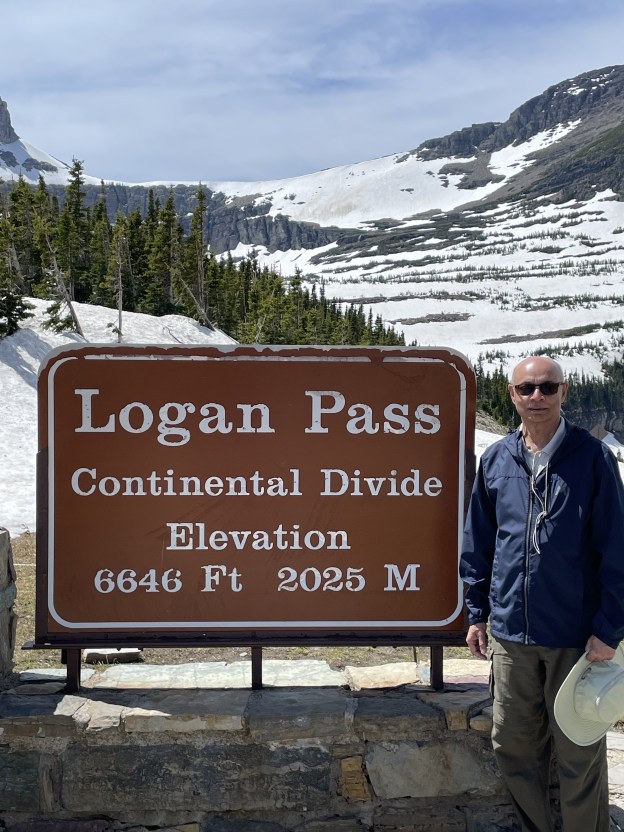
We drove all the way to Logan Pass, the highest point on the “Going-to-the-Sun road and pulled into the parking lot. We were at an elevation of 6646 feet as the picture below shows.

We were lucky. The pass had been cleared of snow and opened just two days back. As proof we stood in front of the wall of ice cleared by the snowplows. It was over our heads, more than six feet high. We had a snowball fight, something we could not do In Pennsylvania this winter—no snow. Global warming, perhaps?

We had some free time and spent it admiring the views, taking pictures and browsing through the gift shop. It was late June but there was still snow on the ground though rapidly melting in the warm sun. Rivulets of water ran everywhere.

Soon it was time to board our Red Buses for the trip back. We went to the parking lot to look for our bus. There were several and I was glad I took note of its unique number and parking spot.
On the journey back we saw strands of burnt trees, a result of periodic forest fires. Paradoxically, fires sometimes help to rejuvenate the forest. Seeds of certain plants like Buckthorn and Coffeeberry need fire, directly or indirectly, to induce germination. Some, like the Lodgepole Pine, due to their protective, resin filled serotinous cones, are the first to germinate after a fire, hence, get a leg-up on the competition.

We saw the vast, unspoiled grandeur of nature—rolling mountain ranges with green flanks and jagged peaks reaching up to the vast blue sky, cotton-wool clouds casting fleeting shadows on the snows below and the warm, bright June sun that warmed our bodies and spirits and made the entire ecosystem flourish on planet earth. I could almost feel life begin to rejuvenate and stir after the long, cold Montana winter.

Soon we were back at the border on the way to Canada. This time we had to fill in a paper form, alight from the bus and pass through a check point where are passports were manually scanned and then continued on to our hotel for the night.

It was a very satisfying, eventful trip to the Waterton and Glacier National Parks. The weather cannot be taken for granted in the mountains, but we could not have asked for anything better. I counted my blessings as I fell asleep.
 Ranjan's Writings
Pingback: My Canadian Rockies Trip, Part 2: Dinner at Kootenai Brown Pioneer Village | Ranjan's Writings