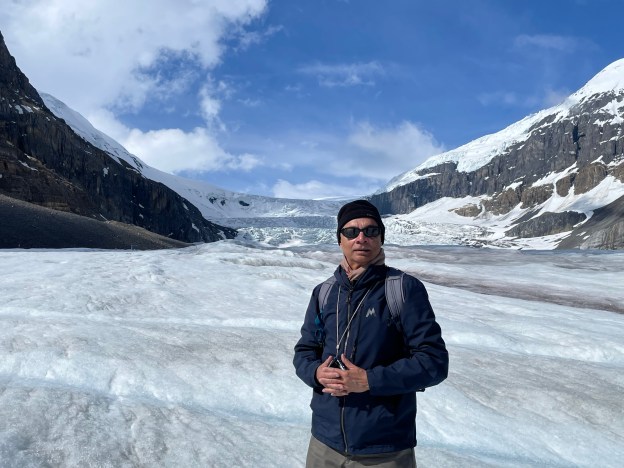
Continued from My Canadian Rockies Trip, Part 6: Maligne Lake and Spirit Island.
Today we would be visiting the Columbia Icefields, walk on a glacier— essentially a river of slow-moving ice, and get an opportunity to drink freshly melted glacier ice that had formed thousands of years ago, hopefully without modern pollutants. To that end, I kept an empty water bottle with me.

Our adventure began with a ride in an All Terrain Ice Explorer shown below.

Our driver and guide explained the mechanics of the vehicle. It had six wheels with low pressure, oversized tires for better traction, an automatic transmission with six gears, crucial to safely navigate inclines up to 35 degrees, and emergency exits in the front and rear. A glacier is a dangerous place with suddenly shifting, humongous blocks of ice. But hearing these details I felt reassured. I buckled up and settled in for the trip. I also heard that many of these vehicles are used by scientific expeditions in Antarctica. That was doubly reassuring.
We slowly climbed up the mountain noting the piles of rubble left by the retreating glacier. Soon we heard the crunch of ice underneath. We were on the glacier headed toward a parking spot alongside other vehicles. We stepped carefully out onto the Athabasca glacier.
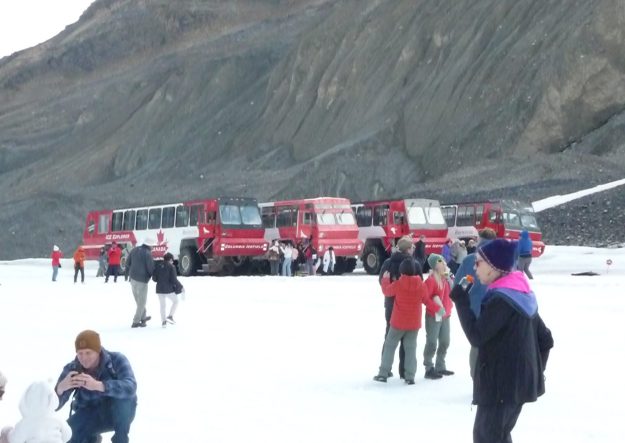
All around us were tourists walking gingerly on the packed snow and taking pictures. Someone had made a snowman visible in the lower left corner of the picture above. Most came prepared in warm clothing and proper footwear. But there would always be that odd person who came in shorts and sneakers.
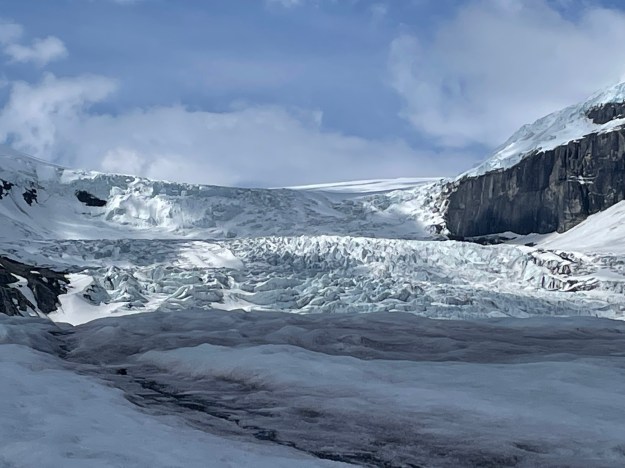
Columbia Icefield, on the border of Alberta and British Columbia, is one of the largest icefields in North America. Meltwater from its glaciers feed many streams and rivers that flow into either the Arctic, Atlantic or Pacific Ocean. Our guide pointed to the head of the glacier where falling snow accumulates, which then over time and increasing pressure, turn into ice that slowly moves downhill. This process has been going on through the ages. As the it moves, it scours and shapes the landscape. We could see the fissures in the glacier which make it so dangerous to walk on. The depth of this icefield is estimated to be 1200 feet. During cold periods (ice ages) the glaciers advance. During warm periods (present time), they retreat. Signs of retreating glaciers are now everywhere across the globe. I will show the picture of the retreating toe later.
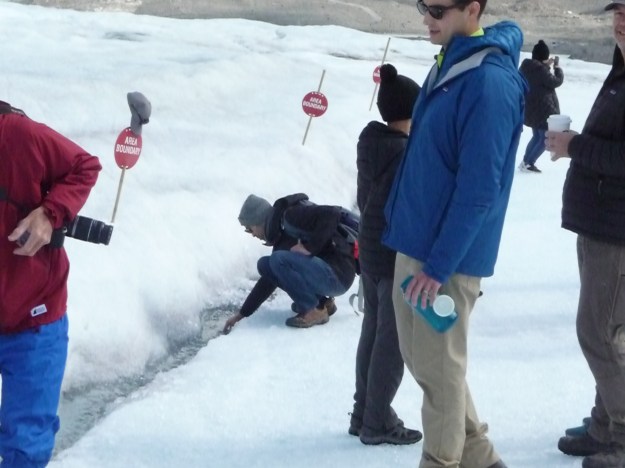
Our guide pointed to the signs marking off the boundary of the safe area. There was a stream of water coming from the melting glacier. We took turns to fill our water bottles. The water was ice cold (not surprising) and very refreshing. With the sun shining it was dazzling and warm, the glare reflected off the ice—intense. I was glad I had on sunblock, hat and sunshades.
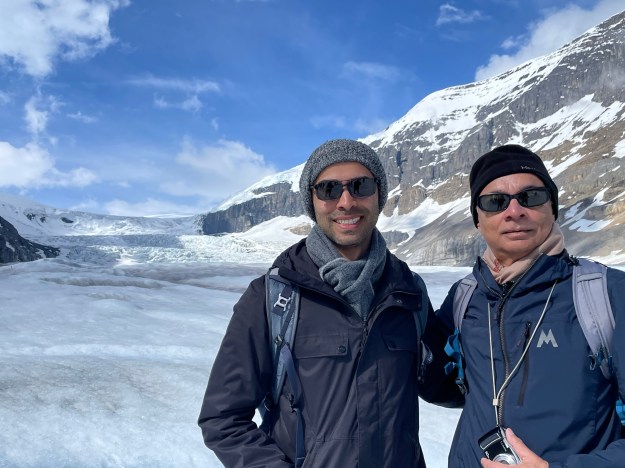
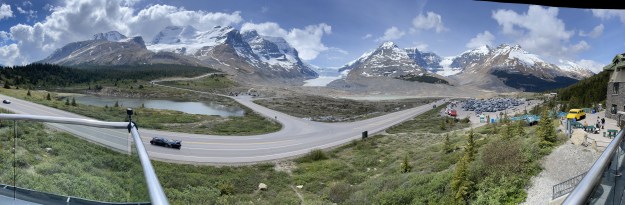
My son and I posed for some pictures. We then headed back to the Jasper Columbia Icefield Discovery Center where we had lunch. We chose to sit outside on the open deck where we could view the surrounding peaks and the glacier. There was a cool breeze from the icefield, but it was June and with the sun, not unpleasant.

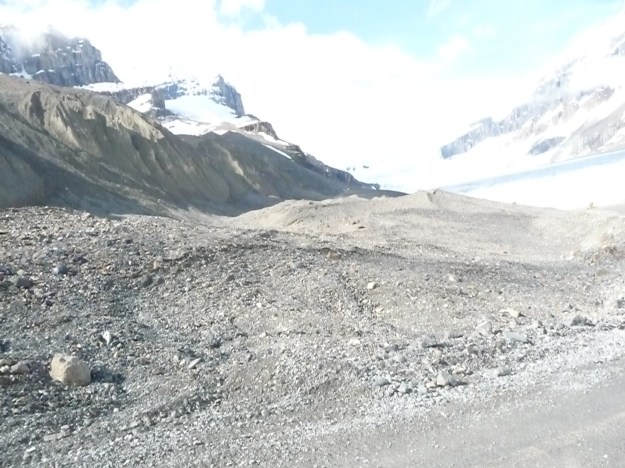
In the picture above you can see the toe (leading edge) of the glacier. Decades back it touched the asphalt road, we were told. Since 1919, it is estimated glaciers in the Columbia Icefields have retreated about 4000 feet. Global warming has accelerated the melting and evaporation. We saw blocks of stone and debris left behind by the retreating glacier (below).
Soon it was time to board our bus and head back to Calgary. We saw more pristine, wooded vistas and azure lakes on the drive.
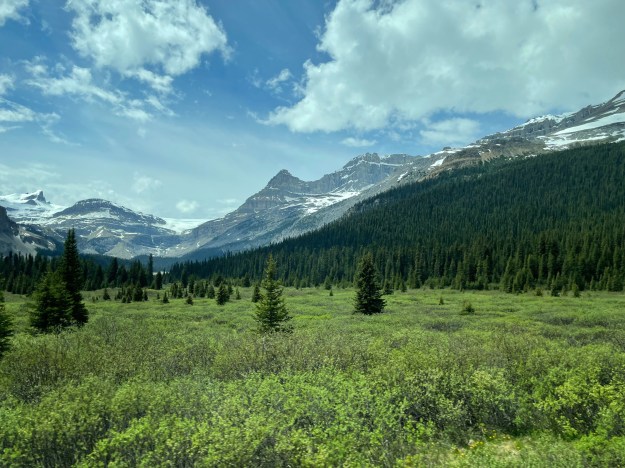
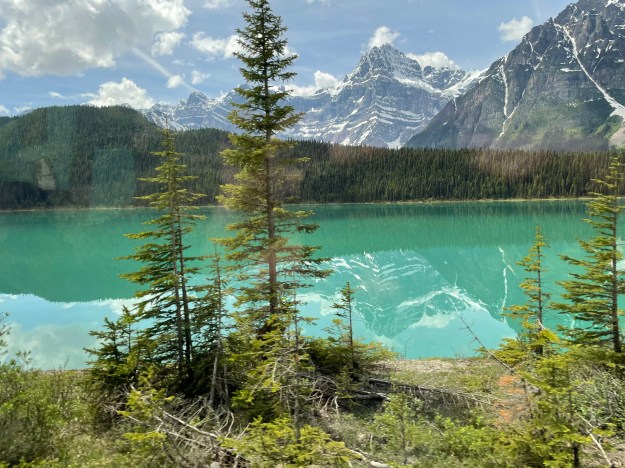
We arrived in Calgary and checked into our hotel. We freshened up and joined our companions for a farewell, celebratory dinner. We had traveled together for eight days and had bonded with many. After dinner some went to explore Calgary. Much as we would have loved to, we went to bed because we had an early flight to catch the next morning.
It had been a wonderful trip. The mountains, lakes, wildlife and pristine wilderness had created indelible memories of a lifetime. Canada is a big country, mostly uninhabited and unspoiled, our friendly neighbor next door.
I fell asleep dreaming of white mountains, green meadows and azure lakes.
End of the Canadian Rockies series.
 Ranjan's Writings