Tag Archives: photography

The Plaza Grande in Merida.

My Mexico Trip, Part 8: Mérida, Yucatán, The Montejos and an excellent Mezcal.

Continued from My Mexico Trip, Part 7: Uxmal.

Mérida, capital of the state of Yucatán, is an old and beautiful city. Founded in the 1540s, it prospered by trading throughout the entire peninsula. The new wealth found expression in lavish villas along the newly formed Paseo de Montejo which was designed to rival the Champs-Élysées in Paris. Many of these villas and estates still exist, transformed into boutique hotels which allow a small glimpse into the laid-back life of the wealthy in those times. After the busy morning at Uxmal, we drove into Mérida to see the city.
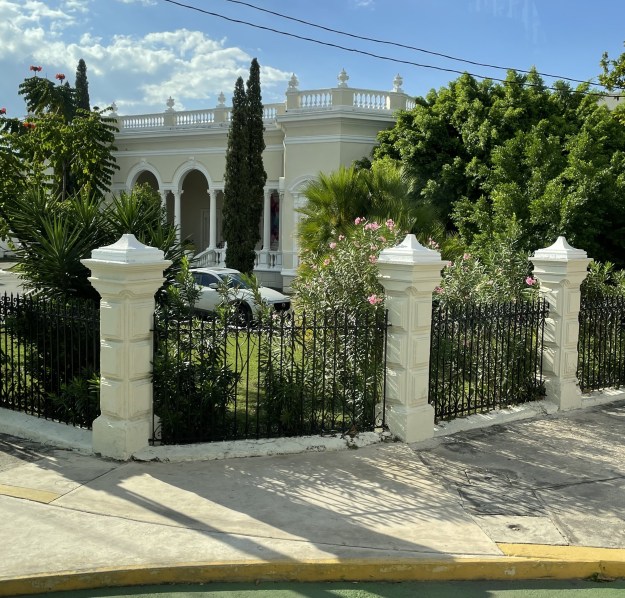
Villa along the Paseo de Montejo, Merida.
Lush gardens surrounding an arched villa on the Paseo de Montejo, Mérida.
Continue reading
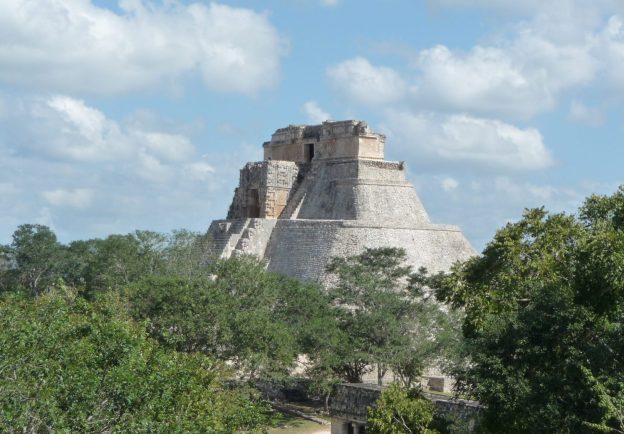
The Pyramid of the Magician, Uxmal.

My Mexico Trip, Part 7: Mystic Mayan Uxmal, Sun and Sand, and a Ballet Folklórico.

Continued from My Mexico Trip Part 6: The Forested Ruins of Palenque.

We got up early for another walk through the lush surroundings of the hotel in Palenque. Our rewards were unique bird-calls and a healthy appetite. After breakfast we boarded our bus and started on the long drive to Mérida. The picturesque forested ruins of Palenque kept going through my mind. What could beat that, I thought! Little did I know of what was yet to come in Uxmal (pronounced Oosh-mal).

Continue reading
Temple of Inscriptions, Palenque, Mexico.

My Mexico Trip, Part 6: The Forested Maya Ruins of Palenque.

Continued from My Mexico Trip, Part 5: Veracruz to Palenque.

We rose to the twittering of birds and the unmistakable calls of howler monkeys coming from high up in the tree tops. My son and I quickly got ready and took a stroll through the lush forested grounds of the hotel, then headed for breakfast. On the way we saw an iguana with a bloody nose. Perhaps it had a run-in with a dog. But it plodded steadily on, where ever it was headed, unfazed. I admired its pluck and resilience.

An iguana, Palenque.
The poor iguana with the bloodied nose at our hotel in Palenque.

Today we would be visiting the famous Maya ruins of Palenque. Located in the state of Chiapas, Mexico, where the gulf plain meets the rising mountains of the interior, it is an area of heavy rainfall and dense forests. Palenque was occupied from around 100 BC, reached its peak from 640 to 730 AD and was largely abandoned by 900 AD. The jungle took over until it was rediscovered and investigated in the nineteenth century. The forest covering was peeled back revealing magnificent buildings from a bygone era. But, only a very small fraction of the area has been explored and archeological digs continue. Who knows what the future may reveal.

Maya ruins, Palenque.
First view of the jungle covered Maya Ruins at Palenque, Mexico.
Continue reading
Palacio Municipal and the Zocalo, Veracruz.

My Mexico Trip, Part 5: Veracruz to Palenque and a Fascinating Dance-Drama.

Continued from My Mexico Trip, Part 4: Popocatépetl, Puebla Cathedral and China Poblana.

After lunching at The China Poblana in Puebla, we headed towards Veracruz. The topography of the land changed gradually. We saw large wind-farms with their long turbine blades turning slowly in the wind —a cheap, clean way to generate electricity—no charge for the wind and no emitted carbon.

Windmills en route to Palenque.
Continue reading
Popocatépetl Volcano

My Mexico Trip, Part 4: Popocatépetl, Puebla Cathedral and China Poblana.

Continued from My Mexico Trip, Part 3, The Archeology Museum.

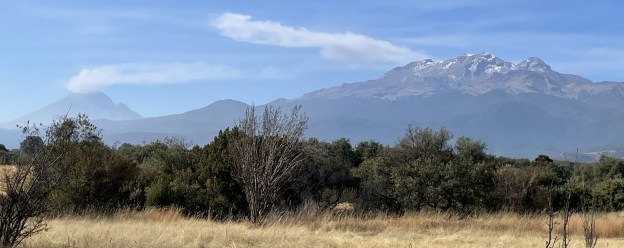
After a busy day in Mexico City visiting Teotihuacán, Zócalo and the Archeological Museum, we headed east towards Puebla and Veracruz. En route, at a rest stop we saw a unique sight—a rock formation in the form of a sleeping woman and Popocatépetl, an active volcano.

Popocatépetl Volcano
Popocatépetl Volcano and The Sleeping Woman, Mexico.

Look at the picture. On the right is a rock formation known as The Sleeping Woman. From right to left you can see her head, her breasts and her feet. It was winter. She was covered with a light dusting of snow. To her left is Popocatépetl, an active volcano, with a plume of smoke from the crater rising into the still air, clearly visible from afar against the light blue sky. The name means “Smoking Mountain” in Aztec. It’s sometimes referred to or abbreviated as “El Popo” in Spanish. I thought I detected a faint, sulfurous redolence in the air. An inevitable comparison to Pompeii came to mind, but I pushed that thought aside. No point in thinking about that eventuality on such a pleasant, beautiful day.

Continue reading