
How did it feel living crammed together in a small sailing ship as it tossed about in the Atlantic Ocean with gale-force winds howling around on the endless journeys bringing emigrants to the New World hundreds of years ago? To find out, I took a trip to the Kalmar Nyckel, a full-scale replica of just such a ship that brought the first immigrants from Sweden in 1638 AD.

I read in the Bucks County Courier Times that the Kalmar Nyckel would be in Bristol, Pennsylvania, from September 8-10, in honor of the annual Italian Day festival hosted by the Bristol Lions. I had my eye on this ship every time I passed it when it was docked in Philadelphia, but never had a chance to visit it. Bristol was closer to me than Philadelphia. I looked up the dates and on a hot but mercifully cloudy Saturday, drove to Bristol.
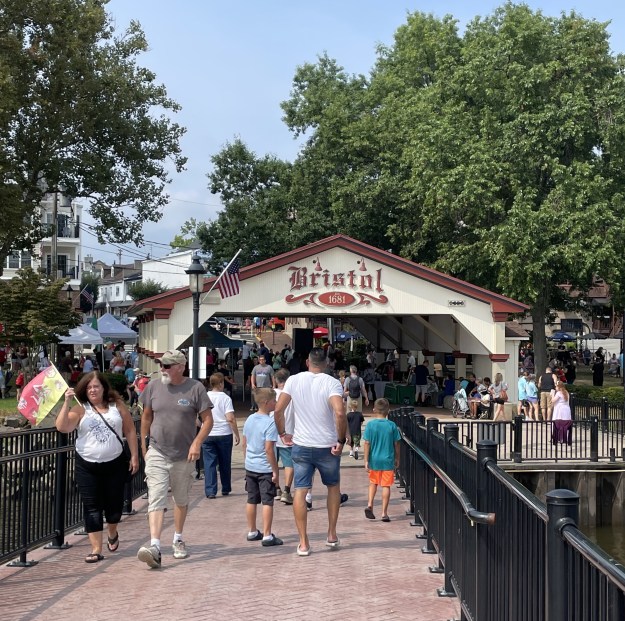
Even from a distance I sensed a big party was under way. People were pouring in, in good spirits, enjoying the last few days of warm weather. I searched for parking, but the lots were full, with several cars circling round, like me, looking for an empty spot. Finally, I parked in a place where I probably shouldn’t have, but I figured that the parking Gods would overlook this minor infraction in keeping with the festivities. I put on some sun block, grabbed my sunglasses and hat and headed for the Kalmar Nyckel.
For ten dollars you can get a guided tour of the deck and for fifty dollars, a two-hour sail on the Delaware River. Buy tickets online. They go fast.
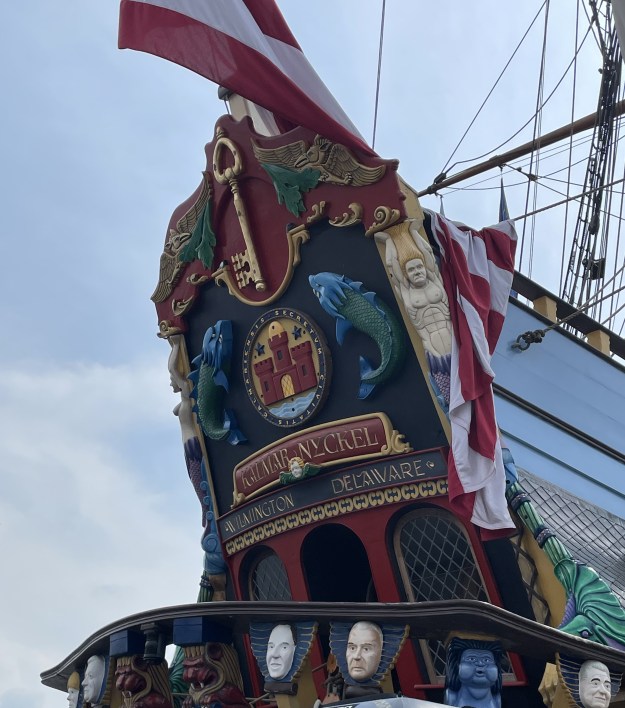
I walked up to where the ship was anchored and paid ten dollars. I got a light blue stamp on my hand indicating I had paid. It reminded me of my graduate student days when my hand would get stamped before entering a bar. I took some photos from the stern (back) of the ship. Soon it was time to board.
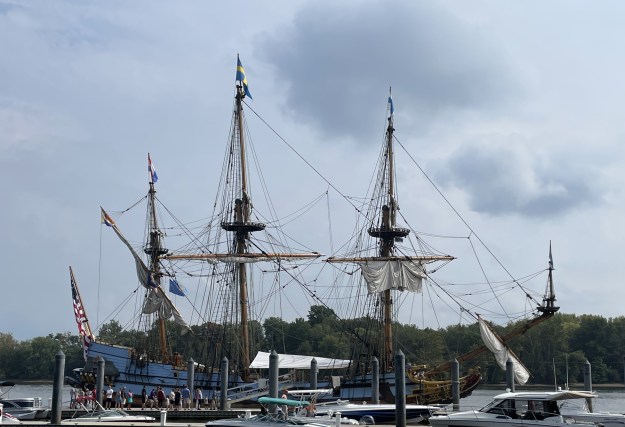
A young woman in a blue shirt with the ship’s logo emblazoned in front, one of the many volunteers who work on the ship, gave us a brief history of the vessel. It brought the first colonists from Sweden in 1638. They built a settlement— the Colony of New Sweden and Fort Christina, in what is now Wilmington, Delaware. In fact, there is a place called Christina and a Christina Mall in Delaware. I used to shop there often, when I was a Delaware resident. Perhaps it was that association and pull that brought me to the Kalmar Nyckel today.
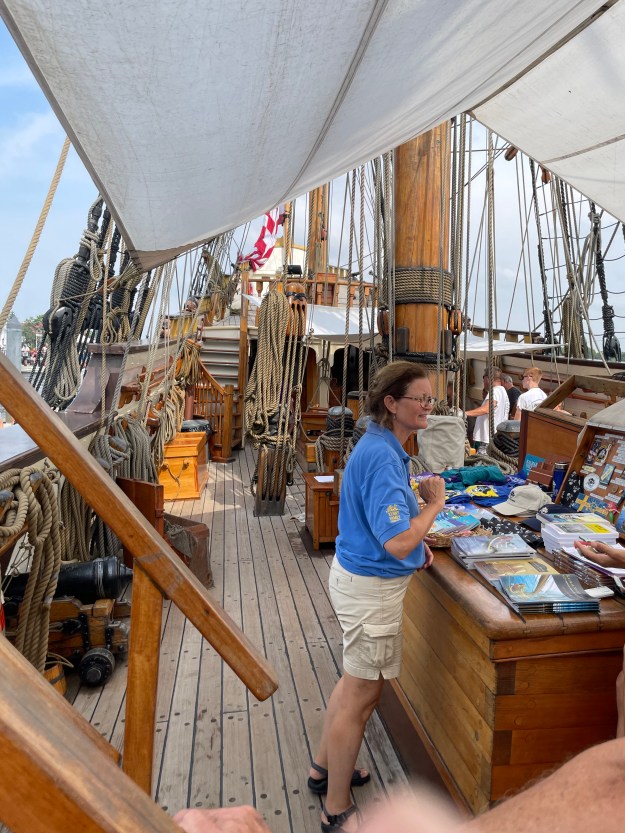
About ten of us walked up the gangway, boarded the ship and stood looking around. The deck area was about 94 ft long and 25 ft wide. The woodwork was polished and gunwale painted. Ropes, ladders, masts and sails were everywhere, neatly arranged and orderly. Shipshape. The etymology of that word dawned on me.
We looked around admiring the painstakingly done full-scale replica of a ship from a bygone era. I took a picture of a 12-pounder cannon near me on the starboard (right) side. The ship had seen battle in her time. A brief history is appended at the end of this post.

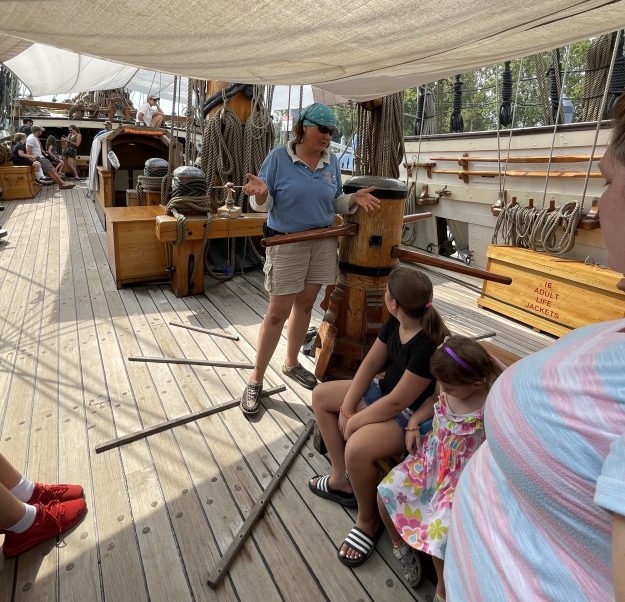
A crew member with a bandana around her head was demonstrating the use of the ship’s capstan, a vertical spool-shaped cylinder rotated manually. Usually a rope is wound around it attached to whatever needs moving. In my mind’s eye I saw men (a strictly male crew in those days) straining to lift a heavy anchor on a sloping, slippery deck. Then I noticed the wooden spars nailed at different angles on the deck. Those gave leverage to the sailors as they pushed the wooden handles. Notice how she positions her right foot as she leans against the horizontal bar that rotates the vertical capstan.
Another crew member standing beside the port (left) side cannon, demonstrated the use of the ship’s windlass, a horizontal cylinder used to raise and lower sails and anchors. It required six men inserting wooden bars into the slots to manually rotate and move whatever was attached to it. A lot of muscle was needed then. That, and wind, were the sole source of power. Later, steam from the burning of coal and petroleum, changed maritime history and our civilization.

We then moved to the stern (rear) and saw some old and new equipment.
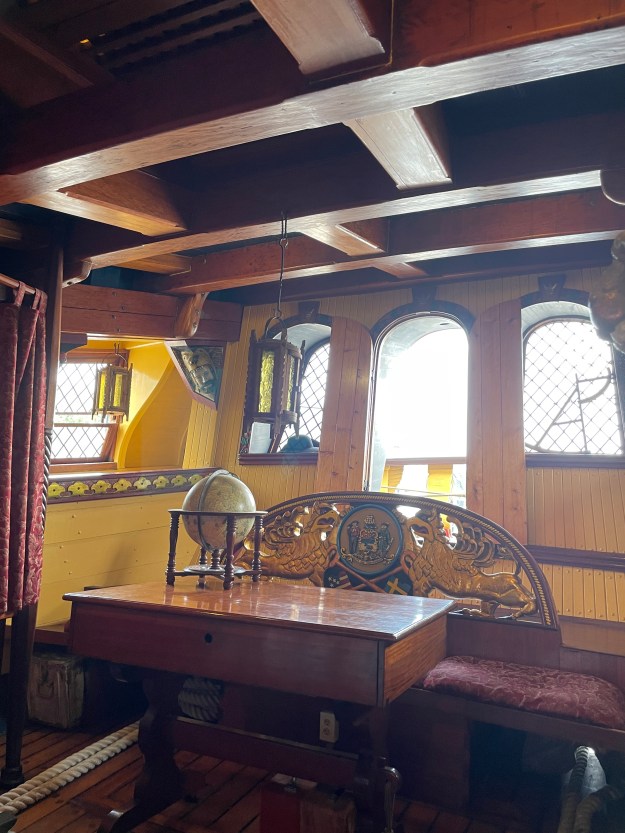
At the rear, overhanging the ship’s rudder, was the captain’s cabin— luxurious, with it’s timbered ceiling, private balcony, paneled windows, brocade curtains and polished furniture with the gilded coat-of-arms of Sweden. He was the Master and Commander, entitled to his privilege. I am sure his crew would agree. Or, maybe not. Who knows? Sometimes conditions drove them to mutiny, but not on this ship.
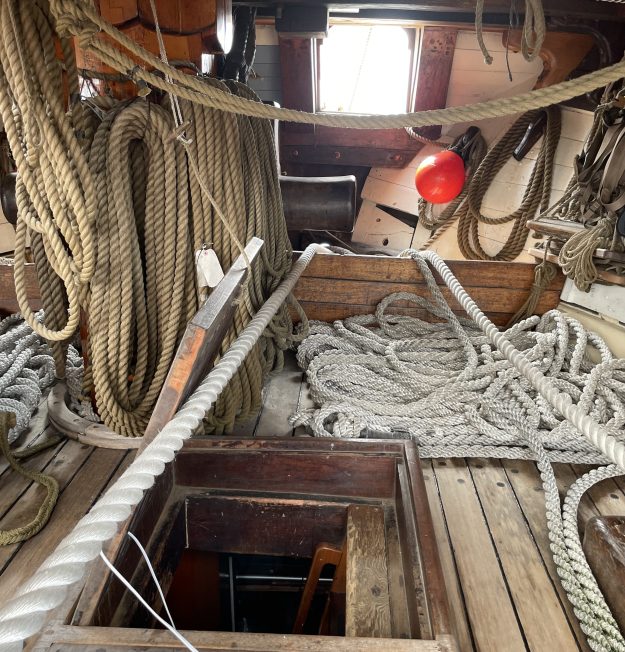
I looked around noticing the piles of neatly coiled ropes and the hatch that led to the deck below. I would have dearly loved to see the quarters below deck and visualize the living conditions of the passengers and crew. It was not hard to imagine the lack of privacy and hygiene aboard ship, the monotonous, unhealthy diet of salt meat and hard biscuits, and cold, wet, miserable conditions. Perhaps people then accepted them as par for the course and we have now grown used to heat and air conditioning and a surfeit of tasty foods that eventually wreak havoc on our health. Funny how the world turns.
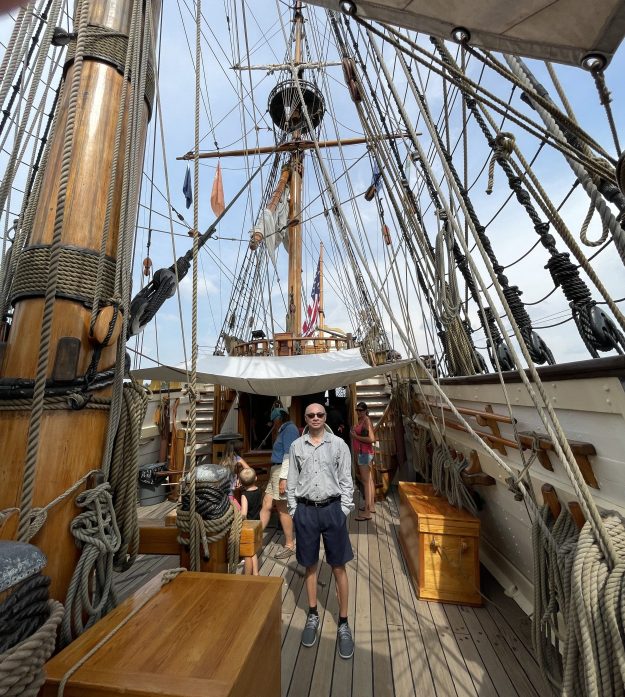
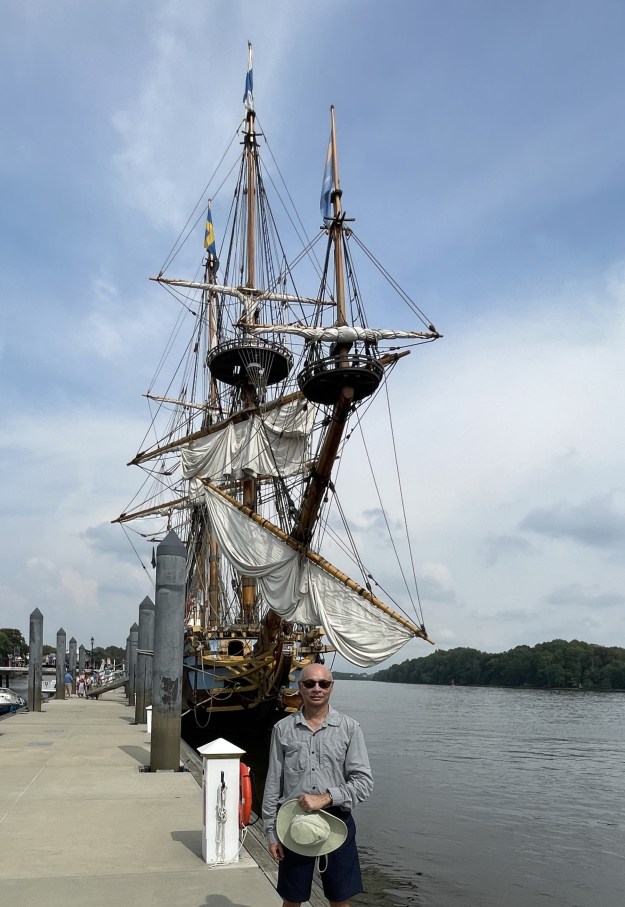
I posed for a picture on deck. I took in the rope ladders reaching all the way to the crow’s nest, the highest point on the ship that gave a 360-degree view and was therefore used as a look-out post. I pictured young sailors, clambering desperately up these ropes in a thunderstorm, lightning flashing, the ropes slippery with rain and ice as the ship listed heavily in the deep swells. How frightened they must have been? Many surely must have fallen off to be lost forever in the watery wastes of Davy Jones’s locker.
I chatted a little with the apprentice sailors and then it was time to disembark. The next batch of visitors were waiting below. I took a final look-around.
I disembarked and walked up the quay to the front of the ship for another picture.
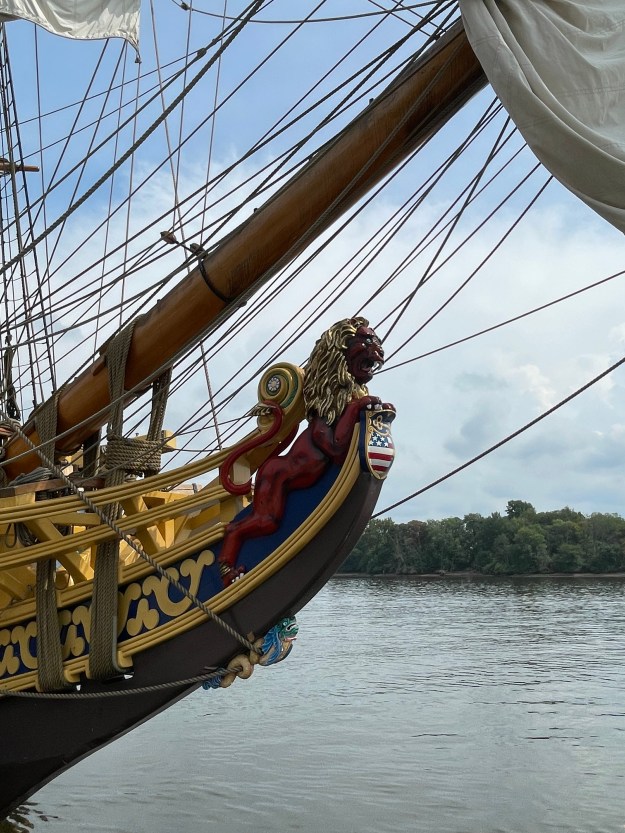
I saw the two-tailed lion on the bow (front), one representing the ancient ship and the other, the new replica.
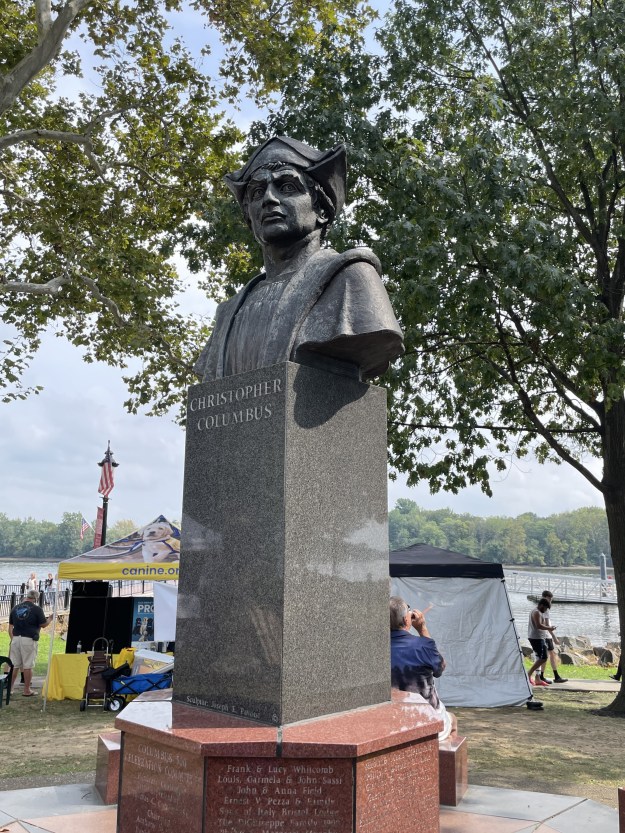
On shore, I walked past the many stalls selling hamburgers, hot dogs, funnel cakes, pastries, drinks and everything that goes into a successful Italian Day festivity. I noticed the statue of Christopher Columbus.
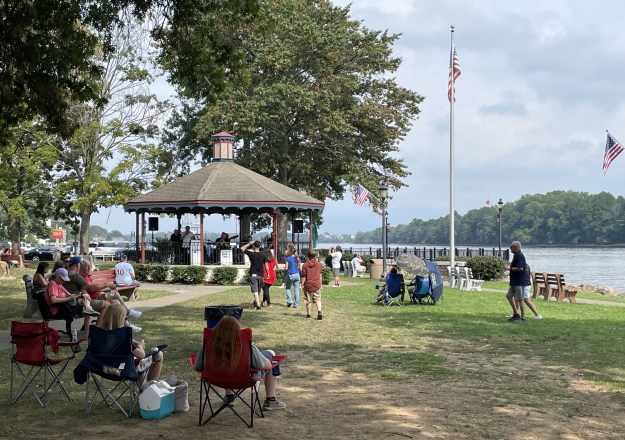
On the way back to my car I stopped to listen to the band playing in the gazebo. This is a nice place to spend a weekend with plenty of good eateries around.
On the drive back I marveled at how far we have progressed in a few hundred years. We now have ships that traverse the Atlantic in days, not months, and can predict the arrival up to the day and hour. Airplanes can cross oceans in hours, and we have nuclear powered submarines that can stay under water for months. But, as with most things in life, there is a tradeoff. We have lost the sense of adventure, the excitement of venturing into unexplored places. There is hardly any unexplored place left on earth today with the exception of perhaps the deep ocean.
Imagine what the Swedes, who stepped off the Kalmar Nyckel onto terra firma in 1638, must have felt as they gradually realized that they had a whole continent before them to explore. Will we ever experience anything like that? I doubt.
A Brief History of the Kalmar Nyckel
Kalmar Nyckel (Key to Kalmar) was the ship that brought the first Swedish migrants to the Delaware Valley. They landed in 1638 and established the colony of New Sweden and Fort Christina which later grew into Wilmington, Delaware. It is credited with four trans-Atlantic crossings, more than any other ship of that time. Built in 1627, it was a gun-armed merchant vessel typical of that era.
In was later sold to the Dutch and, armed with more cannons, saw action in the First Anglo-Dutch war of 1652-1654. It was sunk in the battle of Buchan-Ness during an encounter with the British fleet.
The present replica was built at the Kalmar Nyckel Foundation shipyard and launched in 1997 into the Christina River, very close to the site where the first Swedes were supposed to have landed. Overall, 131 feet long with two diesel engines, it is manned by professional officers and a volunteer crew. A floating museum of maritime history, it recaptures a bygone era when sailing ships connected the globe. It sails along the east coast stopping at various ports for visitors. More information and schedule are available at the sources below.
Sources and links: Wikepedia.org and Kalmarnyckel.org
 Ranjan's Writings
Ranjan, your visit of the replica of Kalmar Nyckel ship that brought Swedish immigrants in 1638 very well narrated. It was interesting reading the history of this ship. Bristol was so close to our home in PA but it never occurred to me that a historic ship replica sits right next to our neighborhood. Now, I make a point to know more about every place that I have an opportunity to visit. Luckily. I am in the Boston metropolitan area, full of history. Yesterday, I visited an office in Wakefield, just 12 miles away from my home in North Andover. Never bothered to know about this place, but when I visited, it immediately looked like a historic city with a huge lake called Lake Quannapowitt surrounded by historic buildings and monuments. Incidentally, this town was originally settled in 1638 and named Lynn Village.
LikeLike
Ajit, thank you for your nice, long comment. Glad you liked it. You can see the ship next time it docks in Massachusetts. Keep an eye on the schedule on the links in my post. Lake Quannapowitt sounds lovely, right up my alley. Must see it, some day.
LikeLike